
Narrow Street lived up to its name. Cars, motorcycles, bicycles, and people passed by, but there was no room for any games.
Jana, Roc, Mei, Saïd, and Berta had to walk to a distant square every time they wanted to play. One Saturday, their ball got away and landed under the baker’s van.
“This street is only good for passing through,” grumbled Roc.
“What if it was also good for hanging out?” asked Mei.
The idea seemed impossible. They couldn’t widen the street or prohibit passage on their own.
They started observing. In the mornings there was a lot of traffic, but on Sundays hardly anyone passed by. In front of the haberdashery, there was an empty corner. The restaurant threw out sturdy wooden crates. The neighbor on the third floor knew a lot about plants.
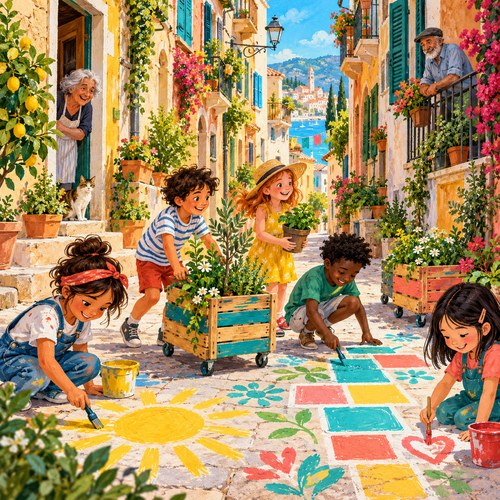
The gang drew a plan. They added a chalk-drawn racetrack, movable planters, and a folding table. Then they went door to door.
“Can we try it one Sunday?” they asked.
The bakery offered breakfast. The mechanic promised to put wheels on the planters. Mrs. Carme donated seeds. Even the bus driver, who didn’t live on the street, brought leftover paint.
Not everyone agreed.
“It’ll be too noisy,” said Mr. Miquel.
“What if we leave it quiet for an hour after lunch?” suggested Berta.
“It’ll block my garage entrance,” warned Lídia.
They moved the racetrack two meters.
On the first car-free Sunday, the planters closed off both ends of the street. The children drew a hopscotch grid, the adults brought out chairs, and Mr. Miquel discovered he was quite good at chess.
That evening, they cleaned everything up. On Monday, the street was once again open for passing through.
But the following Sunday, it became a place to stay once more.
Eventually, the city council installed a sign: “Play Street, Sundays from ten to six.”
The group hadn’t made the street wider. They had achieved something better: they had created a space for more ways to experience it.
