|
Getting your Trinity Audio player ready...
|
When spring arrived, the neighborhood school decided to hold a small fair in the playground. Not a fair to buy things, but a fair of games invented by the children in each class.
In Nora’s class, everyone was talking at once.
“We can have a race!” said Jan.
“A maze!” said Mai.
“A jumping contest!” shouted Biel, who was already jumping before anyone had even said yes.
Amina, who always observed before speaking, raised her hand.
“If we have a race or a jumping contest, we won’t all be able to play equally.”
Everyone was silent for a moment.
Then Nora looked at her friend Lia, who was in a wheelchair and spinning a pencil between her fingers like a little pinwheel.
“That’s true,” said Nora. “And we want a game that everyone can participate in.”
Lia smiled.
“I love scavenger hunts.”
The class’s eyes lit up.
“A scavenger hunt!” several students repeated.
Pau, who wore two blue hearing aids and was excellent at spotting details that others missed, added:
“We can make different kinds of clues. Some to read, some to listen to, some to look closely…”
“And some to touch!” said Mai excitedly. “Like textures!”
The teacher, listening from the board with a smile that said, “That sounds promising,” said:
“Now that sounds like a great classroom idea. If you’d like, I can help you organize it.”
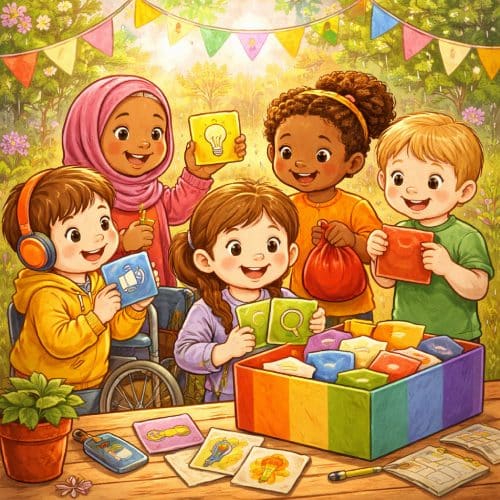
All week long, they worked like a small group of inventors. They decided the game would be called The Box of Colored Clues, because each clue would be marked with a different color and could be solved in a different way.
The green clue would be an image with hidden details.
The blue one would be a short audio recording made with a tablet.
The yellow one would be a riddle written in large print and also with pictograms.
The red one would have shapes to touch inside a cloth bag.
The purple one would have some words in sign language drawn on it, because they had been learning a few in class for months and Sara loved practicing them.
“That’s really nice,” said Jan, sticking an arrow on the cardboard. “But… what if people don’t know how to start?”
“We can put up a sign with clear instructions,” said Amina. “Short and with pictures.”
“And have someone at the beginning to explain it,” said Nora.
“I can stay for a while,” said Lia. “And if the route through the playground goes over the ramp, even better.”
“Not ‘if it happens,’” Pau said. “It has to happen. If it doesn’t, we’ll change it.”
Lia looked at him and tapped the armrest, like when someone says exactly what needed to be said.
The day of the fair arrived with bright sunshine and a light breeze that made the colorful ribbons flutter. In the playground, there were booths with target games, stories, drawing, and construction sets. Nora’s class had decorated their table with paper circles and a large box painted like a rainbow.
The sign read, in large letters with pictures beside it: Choose a clue. Solve it as a team. Find the next one.
The first to try the game was the younger class. A boy picked up the blue clue, held it too close to his ear, and couldn’t hear anything.
“It’s not working!” he said.
Pau went over.
“Wait, you have to press it here,” he said, pointing to the button. And if you want, you also have that sheet with what the audio says.
“Ah!” said the boy. “Can I do both?”
“Yes, of course,” said Pau. “That’s what the game is about.”
A girl chose the red clue and put her hand in the cloth bag.
“I feel something pointy… no, wait… it’s a star!” she said happily.
Lia, from the side, asked her:
“How many points does it have?”
The girl touched it again, concentrating.
“Five!”
“Well, look under the bench with five slats,” said Lia, winking.
They ran there laughing.
After a while, a line formed. Some teams solved the clues very quickly; others took longer. Some preferred to read, some preferred to listen, some had more fun touching the shapes or looking for pictures. And everyone, one way or another, found their moment to say:
“I’ve got it!”
When it was the turn of a group of older children, one of them looked at the sign language clue and wrinkled his nose.
“That’s difficult.”
Sara, who was by the table, smiled.
“I’ll show you a clue. Look, this sign is ‘tree,'” she said, demonstrating the gesture slowly.
The boy imitated her, a little crooked at first, then better.
“Tree…! So we have to look for the tree in the yard?”
“Maybe yes… or maybe no,” Sara said, amused. “Look at the picture too.”
They left, thinking and laughing, repeating the sign for “tree” to each other.
Mid-morning, a strong gust of wind blew two yellow cards and left them under the fountain. Biel ran after them.
“I’ll get them! I’ll get them!”
But one got away and got caught in a small puddle. Before he could even start grumbling, Amina had already taken a clothespin from the materials box.
“With this,” she said, as if she’d had a solution ready ages ago.
“Why do you carry a clothespin in your pocket?” Jan asked.
“Because you never know,” she replied, and everyone laughed.
They dried the card, reattached it, and the game continued.
When the fair ended, the class was tired but happy. Their hands were covered in dried glue, glitter clung to their sleeves, and their cheeks were warm from running and talking so much. They sat in a circle in the playground, while fresh leaves drifted gently above them.
The teacher asked them:
“What did you like most?”
“That everyone could play,” said Nora.
“That there were many ways to solve the same problem,” said Pau.
“That the little ones learned signs,” said Sara proudly.
“That the ramp was part of the course and not an extra lap,” said Lia.
“That when a clue got wet, we fixed it together,” said Amina.
Biel held up his hand straight.
“I liked that the game wasn’t about ‘who goes the fastest,’ but about ‘how we do it.'”
The teacher nodded.
“What you’ve done today is very important. You’ve come up with a fun game, yes. But you’ve also thought about other people. And when we do that, things turn out better.”
Lia looked at the colorful box, a little wrinkled from being opened and closed so much, and said:
“Next year we can do another one… but with new clues.”
“Yes!” they all shouted.
“One at night with flashlights!” said Jan.
“One with smells!” said Mai.
“One with maps!” said Nora.
Pau laughed.
“And an impossible clue… but only one.”
They started tidying up, still talking about ideas, while the playground gradually emptied. And that day, without giving a big speech, they all learned something that stuck with them: that a game is more fun when everyone can participate, and that thinking about others doesn’t take away from the fun… it multiplies it.
And here is a box, here are colors, this story is over… but its clues still provided plenty of fun for many more days.