
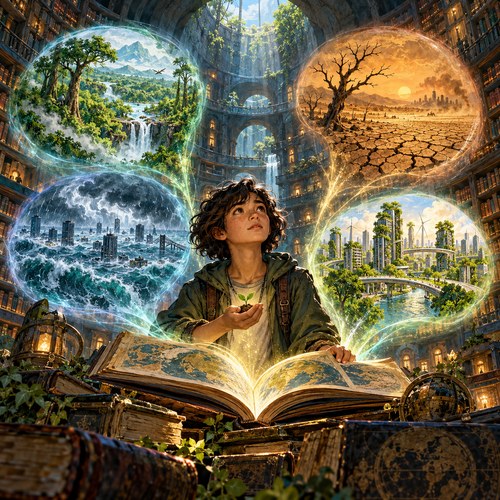
The library was located beneath the old weather station, behind a door that only appeared when the thermometer broke a record.
Elna found it the day her city reached 47 degrees Celsius. She had gone looking for shade among the abandoned buildings and saw a staircase leading down toward a blue light.
Below it were miles of bookshelves.
“Welcome to the Library at the End of the World,” said the librarian.
He was a very old man, or perhaps very tired. He wore a fan around his neck and gloves to handle the books.
“Which ending?” Elna asked.
“All the ones that are still possible.”
The books had no titles. Opening one, Elna saw her city flooded. In another, the trees had disappeared and people were queuing for a bucket of water. A third showed neighborhoods covered in gardens, silent trains, and cool plazas.
“This doesn’t look like an ending,” she said.
“It depends on your perspective.”
Elna wanted to take the book about the green city, but the librarian stopped her.
“Books about possible futures can’t be taken. You can only read one page at a time.”
The first page was blank, except for one sentence: “Plant shade where someone expects it.”
Elna surfaced again. With her neighbors, she installed awnings at the bus stop and planted drought-resistant trees in the schoolyard. When she went back down, a second page had appeared: “Water used once can have another purpose.”
They collected rainwater, repaired leaks, and irrigated with reclaimed water.
Each action revealed a new page. Some were simple; others required difficult decisions. Streets designed only for cars had to be redesigned, buildings renovated, wetlands protected, and companies and governments held accountable.
Not everyone agreed. Some said a city couldn’t change the climate. Others wanted to wait for miraculous technology.
“The library will know if we can do it,” said a councilman. “Let’s just ask for the ending and save ourselves the arguments.”
Elna took him under the station. But when the man tried to open the last page, the book closed.
“There isn’t a last page written,” explained the librarian. “If there were, decisions wouldn’t be decisions.”
Over the years, the city changed. Not fast enough, and not perfectly. There were still heat waves and storms. Some saplings died and had to be replanted. Some projects failed. But the temperatures in the shaded streets dropped, the air became cleaner, and floods found parks where they could spread without destroying houses.
One day, Elna returned to the library and discovered empty shelves.
“Where are all the endings?” she asked.
“Some are no longer possible,” replied the librarian. “I’ve been able to remove them.”
The book about the green city was still there, thicker than before. Elna opened it. On the new page was a photograph of people reading under the trees in a plaza.
Among them, an elderly woman held the same book.
“Is that me?”
“Perhaps,” said the librarian. “This page is still just a suggestion.”
Elna closed the book. She didn’t need to know if that scene would actually happen that way.
She returned to the city with a new instruction: “Explain what you’ve learned before someone else has to start from scratch.”
Years later, when the thermometer stopped breaking records so frequently, the library door became harder to find.
Elna considered this good news.
