
|
Getting your Trinity Audio player ready...
|
Long, long ago, in a small village tucked between the mountains of Catalonia, there lived a farmer named Pau. He worked hard, and his fields were full of wheat, vegetables and flowers. His neighbours often wondered how he managed to grow such lovely things.
One day, as Pau worked in his big straw hat and muddy boots, a friend asked:
“Pau, what is your secret? Why does everything grow so well in your fields?”
Pau blushed and gave a mischievous smile.
“Well, perhaps I have a very special trick… but it is not a very polite thing to explain!”
His friend laughed. Pau joked that even he could help fertilise a field when he needed a poo. It was a silly idea in this story, and one that would inspire a funny little figure. What Pau really did was care for the soil, water his plants when they needed it and work patiently every day.
When Christmas came, Pau and his family made a beautiful nativity scene. They arranged baby Jesus, Mary, Joseph, the shepherds and the sheep. They even made a river from shiny foil that looked almost real. But as Pau admired their work, he thought:
“Something is missing… something special.”
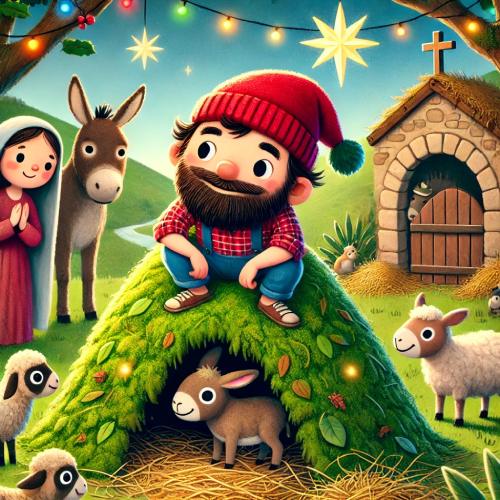
Then he had an idea. He made a small clay farmer, rather like himself, with his trousers down, having a poo in a field. He hid the figure behind a mossy hill. When his children spotted it, they burst out laughing.
“Dad! Why is that farmer having a poo in the nativity scene?” they asked, wide-eyed.
Pau tried to keep a straight face.
“This is the caganer,” he explained. “In our story, he stands for good luck and fertile land. He reminds us of nature and the work of farmers… and gives us something to smile about!”
The children did not understand every part of his explanation, but each time they looked at the little figure, they giggled again. And do you know what happened next? When the neighbours visited Pau’s nativity scene and discovered the hidden farmer, they loved the idea. Soon they were making caganer figures for their own displays, and word spread from village to village.
Over the years, all sorts of caganer figures appeared: bakers, farmers, footballers, famous singers, and even kings and queens. One particularly enjoyable custom remained: hiding the figure behind a bush or a little hill so children could search for it like a treasure hunt.
Every Christmas, finding the caganer gave the family a reason to laugh together. It also reminded them to care for the land, work with dedication and make room for a little humour in life.
And that is the end of this imagined legend about an unusual figure in Catalan Christmas celebrations.
