|
Getting your Trinity Audio player ready...
|
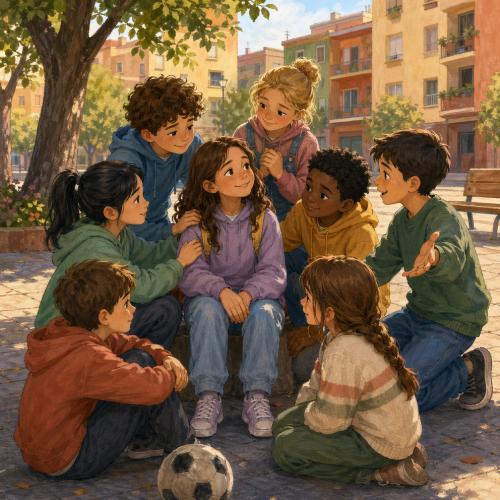
Marc, Elena, Rebeca, Pau, Emma, Anna, and Aitana were in the same class. They were a group that was almost always together: they laughed, played, shared breakfast, and, many afternoons, met in the neighborhood square, where they had a great time.
One morning, while the teacher was writing on the board, some of the group started talking quietly among themselves.
“Shall we meet in the square this afternoon?” Elena whispered.
“Yes! We can bring the ball and play hide-and-seek,” Emma said.
“I’m definitely coming,” Aitana added.
Marc, Anna, and Emma were talking excitedly, but they didn’t say anything to Rebeca. She, who was sitting nearby, heard everything, but no one looked at her or asked if she wanted to come too.
Rebeca felt a twinge in her chest. She didn’t understand what was happening. They always hung out together. Why was this day different?
The school bell rang, and everyone ran out into the playground. The group started playing, but when Rebeca approached, one of the children said to her:
“We want to play by ourselves, since we’re all meeting up this afternoon.”
Those words hit her like a ton of bricks.
Rebeca stood still for a few seconds. She felt very sad, but she still gathered her strength and asked softly:
“Can I join you this afternoon?”
Marc shrugged and replied:
“I don’t know, you’ll have to ask Pau, but since he didn’t come…”
Rebeca didn’t say anything else. She lowered her head and went to a corner of the playground. Her eyes were full of tears, and she spent the rest of the time alone, watching the others play and laugh.
That afternoon, while the gang played in the square, Rebeca stayed home. She didn’t feel like doing anything. She just kept thinking about what had happened and how awful it felt to be invisible.
The next day, Pau went back to school. He hadn’t been there the day before because he’d been sick. When he arrived, Rebeca went to find him at recess.
“Pau, is everyone meeting up today?” she asked.
“Yes, of course,” he said, smiling. “And you’re more than welcome to come too.”
Rebeca looked at him, surprised. When Pau saw her face, his smile faded.
“What’s wrong?” he asked. “Why are you making that face?”
With tears in her eyes, Rebeca told him everything that had happened the day before. She said that they had left her out, that they hadn’t said anything about hanging out, and that they had made it clear in the playground that they didn’t want her with them.
As he listened, Pau grew increasingly serious.
“That’s not right,” he finally said, indignant. “They should never have done this.”
Pau immediately gathered the whole group in the courtyard.
“We need to talk,” he said firmly.
They all looked at each other, not quite understanding what was happening.
“Rebeca explained to me what happened yesterday. You left her alone, you didn’t invite her, and on top of that, you told her you didn’t want to play with her.”
The others lowered their heads. Suddenly, the morning’s cheerfulness vanished.
Emma was the first to speak.
“We didn’t mean to hurt her so much…”
Anna added:
“Yes… I don’t think we considered how she would feel.”
Elena looked at Rebeca and said:
“I’m sorry. We were very wrong.”
Marc also stepped forward.
“You’re right to be angry.” We shouldn’t have left you out.
Aitana, in a soft voice, said:
“We’re sorry, Rebeca.”
Rebeca didn’t answer right away. She was still sad, but seeing that they at least acknowledged what they had done eased her heart a little.
Pau looked at them all and said:
“A real group doesn’t leave anyone out. If we get together, we all get together. And if there’s a problem, we talk about it. But no one should feel left out.”
They all nodded silently.
Finally, Rebeca smiled a little.
“Okay… but I don’t want it to happen again.”
“It won’t,” they all said almost at once.
That afternoon, the whole gang met up in the plaza, as they always should have. They played, laughed, and had a great time together.
But that day wasn’t like any other. That day they learned something important: that true friendship leaves no one behind, and that sometimes a sincere apology can mend what seemed broken.
And from that moment on, whenever someone suggested getting together, Pau reminded them very clearly:
“Everyone means everyone.”
And so, the group from the square continued playing, laughing, and growing together, with more respect, more care, and an even stronger friendship.