
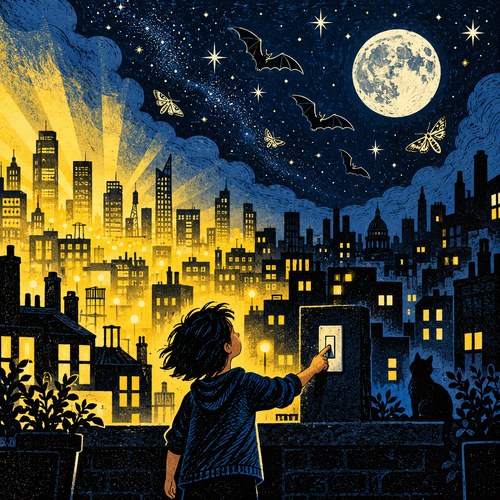
In Claror, the nights shone brighter than the days.
There were streetlights on every corner, signs that never slept, and spotlights that illuminated even the empty rooftops. People said it made the city more modern.
But Laia had never seen the Milky Way. Nor had she ever seen an owl. And she was beginning to suspect that the moon had grown tired of visiting them.
One night, she climbed to the rooftop with binoculars. She peered between two neon signs and saw a very pale light.
“Moon?” she shouted.
“I’m here,” replied a weary voice. “You can’t see me.”
Laia ran downstairs and told the mayor.
“We can’t turn off an entire city to look for something that might not even be there,” he said.
So Laia started with her balcony. She turned off the outside light. The neighbor across the way, intrigued, turned his off too. The bakery disconnected its sign when it closed. The librarian directed the spotlights downwards.
Each night someone else joined in.
They didn’t leave the streets in darkness. They covered the streetlights so the light went where it was needed. They put timers on the shop windows. They kept the important lights on and turned off the ones that weren’t useful to anyone.
After a week, a star appeared above the square.
The next day there were seven.
Then the bats returned, eating the mosquitoes. Colorful moths arrived that no one remembered. The neighbors started having dinner on their balconies to look at the sky.
On the night of the great voluntary blackout, the whole city counted:
“Three, two, one!”
The unnecessary lights went out at once.
The moon was there, round and clear. It had never left.
The mayor stared at the sky, his mouth agape.
“It seems we’ve found something very ancient,” he said.
“No,” Laia replied. “We’ve stopped covering it up.”
From that day on, Claror still had light, but it no longer used it to banish the night.
