
At the end of Linden Lane was a workshop with a small sign: “We fix almost everything.”
Mrs. Mei repaired clocks, umbrellas, and toys. One Monday, three difficult cases were brought to her: a doll missing an arm, a train with a broken wheel, and a teddy bear with a large tear in its belly.
“Tomorrow you’ll be back to normal,” said Mrs. Mei.
But that night, when the workshop was empty, the toys began to talk.
“I don’t remember what I was like before,” said the doll. “I’ve been missing my arm since I was found during a move.”
“My wheel has already broken three times,” explained the train. “If they put on the same one, it will break again.”
The bear looked at its open belly.
“I don’t want to hide that mark. I got it escaping from a dog’s teeth.”
The next day, Mrs. Mei looked for identical pieces. She couldn’t find any.
“I’m sorry,” she sighed.
Amina, her granddaughter, who was spending the afternoon in the workshop, listened to the toys in silence. Then she opened the box of strange materials.
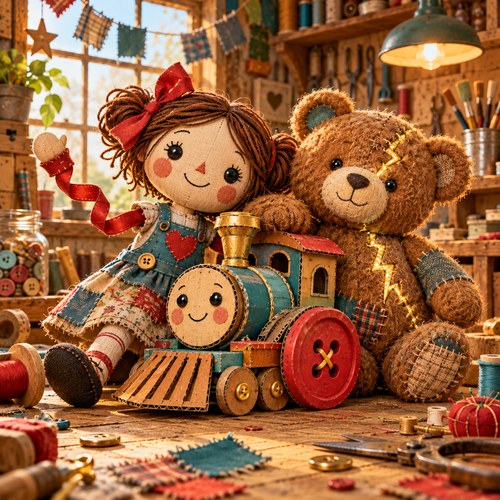
She made the doll a flexible arm with a red ribbon and a wooden hand. Now it could hug things of different sizes.
She put a wheel made from a large button on the train. It was slower than others, but it allowed it to turn in very small spaces.
She sewed the bear’s belly with gold thread, leaving the scar clearly visible like a lightning bolt.
“They’re not quite the same as before,” said Mrs. Mei.
The toys tried out their new bodies.
The doll picked up a ball and a pencil at the same time. The train made a perfect turn around a cup. The bear showed off its scar in front of the mirror.
“They’re ready to go,” replied Amina.
Mrs. Mei changed the workshop sign. From that day forward it read:
“We don’t make things new. We help them have a new life.”
And beneath the sign were drawn a button, a red ribbon, and a golden lightning bolt.
