
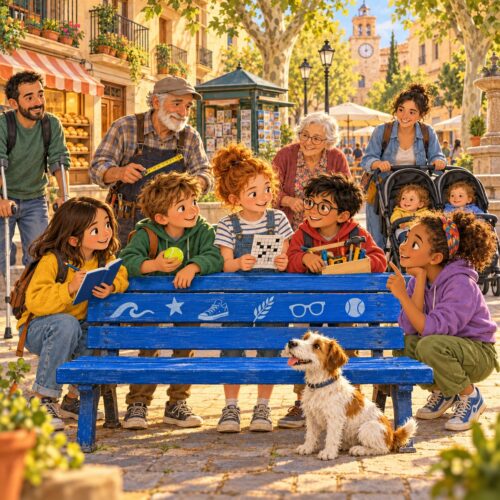
In the middle of the Clock Square stood a blue bench.
It wasn’t the newest or the most comfortable. One leg was slightly crooked, there were two green paint stains, and a line someone had drawn with a marker. But it was the group’s bench.
Jana sat there drawing. Saïd bounced a tennis ball. Mei worked on the crossword puzzle in Grandpa’s newspaper. Roc took apart broken toys and sometimes even put them back together. And Cèlia, who didn’t talk much but observed a lot, greeted everyone who crossed the square.
Every afternoon, at 5:30, the blue bench became the group’s headquarters.
However, one Monday they found it surrounded by red and white tape.
“PROHIBITED,” Saïd read, emphasizing the syllables. This doesn’t look good.
There was a note stuck to the back of the bench.
“Bench out of service. It will be removed on Friday.”
“Removed?” Jana asked. “Where will they take it?”
“Maybe they’ll give it a pension,” Roc said.
No one laughed much.
The leg of the bench had cracked. When Saïd touched it with the tip of his shoe, it made a squeaking sound.
“We can’t sit on it,” Cèlia said. “But that doesn’t mean they have to throw it away.”
They went to ask at the newsstand. Mrs. Mercè, who knew almost everything before it happened, explained that the City Council would remove the bench because it was old. Perhaps, in a few months, they would put in a new one.
“A few months?” Saïd protested. “And in the meantime, where are we supposed to hold our meetings?”
“You can meet standing up,” Mercè said.
“Meetings standing up don’t last long,” Mei observed.
That afternoon they sat on the ground next to the tape. After five minutes, Roc had a grate mark on his pants and Jana had rested her elbow on a piece of chewing gum.
“We need a plan,” she said.
“I can fix the leg,” Roc said.
“You fixed my alarm clock and now it goes off at four in the morning,” Mei reminded him.
“But it goes off,” he replied.
Cèlia looked at the bench, the square, and the people passing by.
“Before we make a plan, we need to know who it’s important to.”
The next day they began an investigation.
Jana prepared a notebook with a blue cover. At the top of each page she wrote: “What are you doing on the blue bench?”
Miquel, the baker, replied, “I rest when I take the loaves of bread to the senior center.”
Alba, who was pushing a stroller with two twins, said, “I give the children their afternoon snack. If I don’t sit down, one cries and the other scatters cookies to the pigeons.”
Mr. Tomàs was waiting for his card-playing partner. Nadia, who walked with crutches, stopped halfway to the pharmacy. Fina was sunbathing. The delivery man was organizing the addresses. Three high school students were reviewing exams.
Even the hairdresser’s dog was taking advantage: lying down in the shade cast by the back of the bench.
In two days, they filled twenty-seven pages.
“The bench isn’t ours,” Mei said, going over the list.
Saïd wrinkled his nose.
“Is this bad news?”
“No. It’s better. It means there are more of us.”
Jana drew a poster:
SAVE THE BLUE BENCH
They’re taking it away on Friday. Meeting in the square on Thursday at six. Bring ideas. And a chair.
They posted copies at the bakery, the pharmacy, the senior center, and the school gate. Mrs. Mercè put one up at the newsstand, next to the cooking magazines.
On Thursday, at five to six, only the group and four plastic chairs were in the square.
“It’ll be a small meeting,” Roc said.
At six o’clock sharp, Nadia arrived. Then Alba arrived with the twins. After that, Mr. Tomàs arrived with his card-playing partner, whose name was Amadeu and who was carrying a tape measure. Fina, Miquel, the three high school students, the hairdresser (without the dog), and the dog (without the hairdresser’s permission) all arrived.
In the end, there were thirty-two people, six chairs, a stool, and a double stroller.
Everyone was talking at once.
“Let’s have a protest!”
“Let’s buy a new bench!”
“I have two pallets!”
“Pallets aren’t comfortable, Ramón!”
Mei tapped together two spoons she had ordered at the bar.
Clink, clink!
“First, we need to know if it can be repaired,” she said.
Amadeu had worked as a carpenter for many years. He bent down without touching the tape and examined the leg.
“The wood is damaged, but the rest is fine. We’d have to replace this piece, tighten the backrest, and sand down some splinters.”
“And paint it,” Jana added.
“Is that essential?” Saïd asked.
“Absolutely.”
Cèlia took notes on everything. Then they divided up the tasks.
Mei would find out how much the materials cost. Roc would help Amadeu draw a technical drawing of the piece. Jana would prepare a letter. Saïd would collect signatures. Cèlia would talk to everyone who couldn’t make it.
“And what will the adults do?” Miquel asked.
“Listen when we get stuck,” Cèlia said. “And help with the dangerous parts.”
The next morning, before going to school, the group already had 103 signatures, a budget, three photographs, and a letter that began like this:
This bench isn’t just four pieces of wood. It’s a place where people rest, wait, talk, and meet.
That afternoon, they went to the neighborhood office. They were greeted by a municipal technician named Olga, who wore red glasses.
She read the letter. She looked at the photographs. She studied Amadeu’s drawing.
“You’ve done a very thorough job,” she said. “But you can’t repair public furniture on your own. There are safety regulations.”
Roc lowered his head.
“We already knew that,” said Cèlia. “That’s why we came.”
“The bench has to be removed tomorrow,” Olga continued. “The order has already been given.”
The group fell silent.
Then Jana saw that Olga was still flipping through her blue notebook.
“But,” the technician added, “removing it doesn’t mean throwing it away. I can ask them to take it to the municipal workshop. If the structure is safe, they can repair it.”
“And how long will that take?” asked Saïd.
“I won’t lie to you. There’s a waiting list.”
Mei opened her budget.
“We can contribute the money for the materials.”
“And the square can wait without being left empty,” said Cèlia. “We have another idea.”
That Saturday, the blue bench was gone. However, in its place appeared twelve different chairs.
There was a kitchen chair, three patio chairs, a folding chair, a rocking chair that wouldn’t stay still, and a child’s chair that only half of Saïd could fit in.
Each chair had a label: “Sit here, but return it to the kiosk at night.”
The plaza was a bit comical. It looked like a restaurant had had a fight with a bar and both had spilled out onto the street.
But it worked.
People sat down, the chairs were moved around, and when someone needed one, there were always hands ready to lend them one. The three high school students painted a sign with a day counter. Miquel left a piggy bank shaped like a loaf of bread. The twins dropped in two buttons, a stone, and finally, a real coin.
After a week, they had collected enough money for the materials. Two weeks later, Olga sent them a photograph of the bench in the workshop. Three weeks later, the news arrived: the structure was safe and the repairs had begun.
“How much longer?” Saïd asked every afternoon.
“Less than yesterday,” Mei replied.
The bench returned one Thursday morning.
It had a new leg, a sturdy backrest, and the wood was nicely polished. The workers had left it unpainted because Jana had requested one last job for the neighborhood.
That afternoon, under Amadeu’s watchful eye and with cans of outdoor paint, everyone left a small blue mark: a wave, a star, a shoe, an ear of wheat, glasses, a dog, two crutches, a tennis ball, and twenty-seven other things.
Roc painted an alarm clock with the hands set to four.
“This joke will never die, will it?” he asked.
“Never,” Mei said.
When the paint dried, no one rushed to take the first seat. Nadia sat down to rest. Then, Mr. Tomàs and Amadeu started a game. Alba handed out the twins’ snacks without wasting a single cookie.
The gang sat down on the ground in front.
“So much work and we’re left with no space,” Saïd complained.
Cèlia pointed to the chairs scattered around the square.
“Now we have plenty.”
Jana opened her blue notebook to a new page and wrote:
Next issue: the fountain that splashes everyone except the thirsty person.
Roc jumped up.
“I know how to fix that!”
“You don’t touch the fountain!” they all shouted at once.
And the laughter of the group, the families, the grandparents, and the neighbors filled Clock Square from end to end.
