|
Getting your Trinity Audio player ready...
|
Long, long ago, there was a valley full of very different animals. They all lived in peace, but the place was slowly changing. Some seasons were very dry, others very rainy, and sometimes food was easy to find… and other times it was very difficult.
In the middle of the valley lived the wise Tortoise, who had been observing nature for many years.
“Nature is always changing,” she said. “And so are we.”
One morning, all the animals gathered around a large tree.
“Why do giraffes have such long necks?” asked a little rabbit.
A very large giraffe smiled.
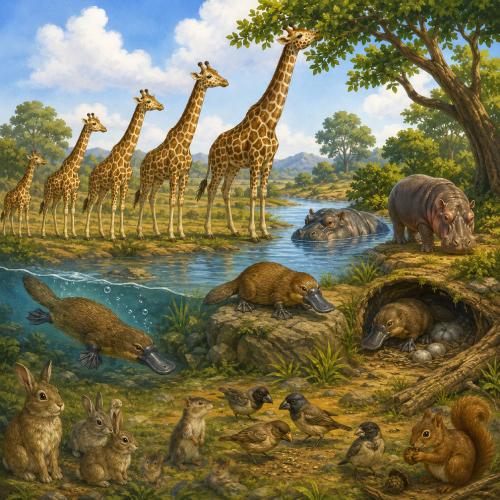
“My ancestors didn’t have necks as long as mine. Some had slightly shorter necks and others slightly longer ones.” When the lower leaves began to disappear, those that reached a little higher could continue feeding.
“And then what happened?” the birds asked.
“Those giraffes grew up healthy, had offspring, and many of those offspring also had slightly longer necks. After many, many generations, giraffes ended up with necks as long as you know them today.”
Tortoise nodded.
“It didn’t happen in a day, or even a year. It happened very slowly.”
Then a hippopotamus emerged from the water.
“And I have a story too!”
Everyone listened attentively.
“My ancestors walked much more on the ground. But the sun was very hot, and the water was a cool and safe place. Those who spent more time in the rivers were better protected from the heat and also found shelter.”
“And now you spend all day in the water!” laughed a frog.
“Exactly! We still walk on land, but our bodies are very well adapted to living between the water and the shore.”
At that moment, a very strange animal swam by.
It had a duck’s bill, a wide tail, webbed feet, and very thick fur.
The new animals always looked at it in amazement.
“What are you?” asked a fox.
“I’m a platypus.”
“But… you have parts of many animals!”
The platypus laughed.
“No. It’s just that my ancestors changed very slowly. My bill helps me find food underwater, my feet help me swim, and my fur keeps me warm when the river is cold.”
Tortoise drew a circle in the sand.
“Many people think that animals change because they decide to. But that’s not the case.”
The little animals were surprised.
“No?”
“No.” Each offspring is born slightly different from the others. Some differences are more helpful than others. If a trait is useful for living in a particular place, the animals that possess it tend to survive better and have more offspring. And these offspring often inherit that trait as well.
“Like a very long race?” asked a hare.
“Exactly! But a race that lasts thousands and thousands of generations.”
Suddenly, a beaver raised its tail.
“Is that why I have such strong teeth?”
“Yes. Your ancestors who were better at gnawing on tree trunks could build safer shelters. Over time, that skill became more and more common.”
An owl spread its wings.
“And my big eyes?”
“They help you see at night. Owls with better vision found more food and took better care of their young.”
All the animals began to look at each other differently.
The rabbit’s paws.
The squirrel’s claws.
The eagle’s wings.
The fish’s fins.
Each animal had something special that helped it live in the place where its family had grown up for countless generations.
As the sun began to set, Tortoise spoke the last words.
“No animal is better than another. Each one is adapted to its own world. And nature keeps changing. That’s why life keeps changing too, generation after generation.”
That night, all the animals went home thinking about their ancestors.
They understood that the great differences in nature hadn’t appeared suddenly or by magic.
They were the result of millions of small changes, many generations, and a long history of adaptation.
And from that day on, every time they discovered a new animal, instead of wondering why it was so different, they asked themselves:
“What adventure did its species go through to become that way?”