|
Getting your Trinity Audio player ready...
|
Pol is a very active five-year-old boy. He likes to play with his cars, draw pictures, and run around the park. But when it’s time to eat, he often prefers to keep playing and says he isn’t very hungry.
One lunchtime, Mom prepared rice with vegetables. The dish smelled delicious and was very colorful. The whole family sat down at the table.
“Pol, have some food,” said Mom. “Just what you can eat.”
Pol had some rice, but after a while, he said:
“I don’t want any more.”
His father looked at his plate, where there was still quite a bit of food left.
“You know, Pol?” he said calmly. “This food is very important. Many people have worked hard so that we can have it.”
Laia added:
“If we throw it away, it will spoil, and we won’t be able to use it.”
Pol looked at his plate and sat there thinking.
That afternoon, while he was playing, he saw his mother in the kitchen putting the leftover food into jars.
“Mom, what are you doing?” he asked.
“I’m saving the leftover food,” she replied. “That way we can eat it another day and we won’t throw it away.”
“Oh…” said Pol. “That way it won’t go to waste.”
“Exactly,” his mother said, smiling.
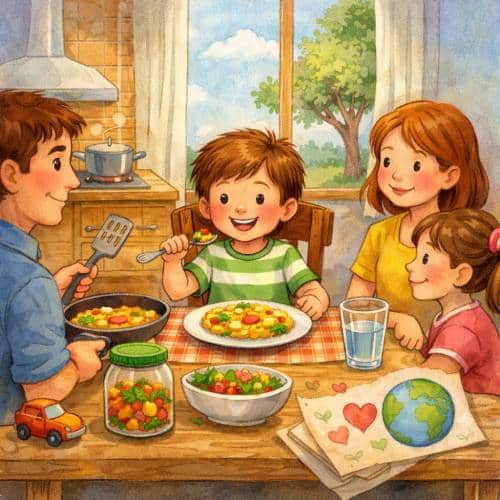
That night, Dad made an omelet with the leftover vegetables. Pol smelled something delicious.
“What are you cooking, Dad?” he asked.
“An omelet with the vegetables from lunch,” he replied.
At the table, Pol tasted the omelet.
“Mmm! It’s really good!” he said happily.
“See how using up leftover food is a good idea?” said Laia.
The next day, at lunchtime, Pol wanted to do better. He put less food on his plate.
“That way I’ll finish it all,” he said.
And so he did. When he finished, he smiled proudly.
“Very good, Pol,” said Dad.
“We’re very happy with you,” said Mom.
From that day on, Pol learned that food is very valuable, that it shouldn’t be wasted, and that using it wisely is a way to care for the world and for people.