
|
Getting your Trinity Audio player ready...
|
In the little village of Vilafesta, everyone celebrated Carnival with joy. Parades filled the streets with colourful costumes and music. People danced and laughed all day long. But when Ash Wednesday arrived, the celebration changed.
That day, the villagers gathered to say goodbye to Carnival with a special event: the burial of the sardine. This old custom marked the end of Carnival fun and the beginning of Lent, a quieter time for reflection.
Martí, a lively seven-year-old, had never understood why anyone would bury a sardine.
“Why do we do this?” he kept asking.
“Because it’s our tradition!” Grandma Remei replied.
But Martí wanted to know more. That year, he decided to take part so he could understand it better.
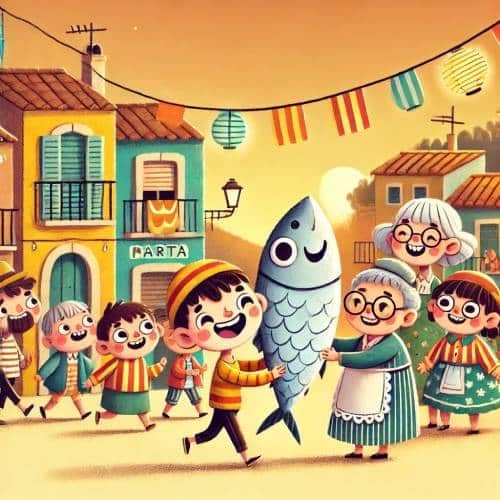
On Wednesday evening, the whole village gathered in the square. A group of grown-ups dressed as mourners pretended to cry very loudly. They carried a giant cardboard sardine on a wooden board, as though it were a real funeral. The children followed with lanterns, pretending to accompany the fish on its final journey.
Grandma Remei bent down beside Martí and whispered:
“We do this to say goodbye to the party and welcome a quieter time. But most of all, we do it because it is part of our story—a story that brings our village together.”
Martí began to understand. When it was time to put the sardine into a sandy hole prepared in the square, he was the one who carefully lowered it in.
After the celebration, Martí felt happy. Now he knew that traditions were about more than having fun. They helped people remember who they were and share special moments with family and friends.
“Next year, I’m going to make the sardine!” he announced excitedly.
And thanks to Martí and the other children, the burial of the sardine would remain part of life in Vilafesta for many years to come.
