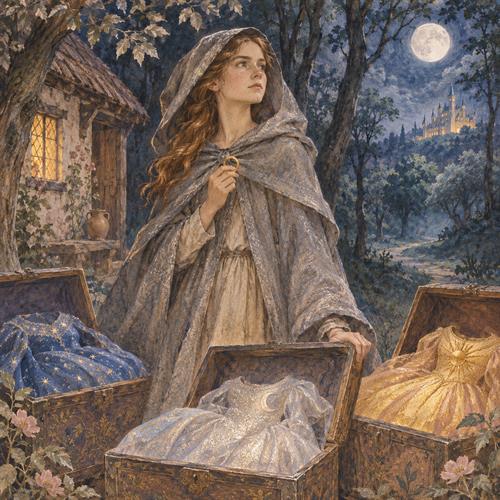
In a distant kingdom lived a king, a queen and their daughter. The country was prosperous, and in the palace courtyard stood a magical donkey that left gold coins on the straw each morning.
The princess grew up loved and learnt to listen to the people, manage the granaries and defend her opinions.
Then the queen fell ill. Before she died, she asked the king to make no important decision while grief still ruled him.
The king promised, but did not keep his word. He shut himself away, stopped listening to his counsellors and allowed sorrow to confuse his thoughts.
One day he announced that he would force his daughter to occupy the place of both princess and queen through a marriage that should never have been proposed.
“No,” she answered. “I am your daughter, and I have the right to decide whom I marry. Grief cannot turn an injustice into a duty.”
Blinded by his wish to control everything, the king would not listen.
The princess sought help from her godmother, a fairy who lived at the edge of the forest.
“You must not submit to an unjust command,” said the fairy. “We shall gain time, and then you will leave for safety.”
The princess asked the king for a gown the colour of the sky. She believed nobody could make it.
Yet the weavers worked for seven days and created a gown that changed from the blue of dawn to the blue of night.
She then asked for a gown as bright as the moon. The silversmiths spun moonbeams and finished that one too.
Finally, she asked for a gown as radiant as the sun. The craftsmen wove golden threads until the whole chamber shone.
None of these trials made the king think again.
“It is time to go,” said the fairy.
She placed the three gowns inside a chest no larger than a walnut. Then she made a grey cloak from the rough wool the magical donkey shed each spring.
“This cloak will hide the gowns and your face. While you wear it, people will know you as Donkeyskin.”
That night, the princess left a letter explaining that she had gone to protect herself and would return only when her choice was respected.
She crossed the forest and reached another kingdom. Nobody recognised the figure beneath the grey cloak.
A royal farm offered her work. Donkeyskin fed the geese, cleaned the stables and helped bake the bread.
The work was hard, but for the first time she could decide when to speak, where to walk and who she wished to be.
On Sundays, when she was alone, she opened the little chest. She wore one of the gowns and reminded herself that the cloak was only a disguise, not her identity.
One day, the prince of that country passed the farm. Through a window he saw a young woman in a sky-coloured gown reading a book.
When he looked again, only Donkeyskin remained in her grey cloak.
The prince asked who she was, but nobody knew. Instead of spying on her or giving orders, he began visiting the kitchen and talking with her while they kneaded bread.
They spoke about books, harvests and how a ruler should listen before making decisions.
In time, Donkeyskin came to trust him.
During the spring festival, she removed the cloak and appeared before the court in her sun-bright gown.
“I am a princess, but I fled because others tried to decide my future without my consent. I am not looking for someone to rescue me. I seek allies who respect my choices.”
The prince bowed.
“Your story belongs to you. If you ever wish to share your road with me, it will be because we have both chosen it.”
The princess stayed in the kingdom and joined its council. She improved the granaries, the schools and the laws protecting those who had to flee their homes.
Months later, a letter came from her father. His counsellors had made him face the harm he had caused. The king admitted his injustice and promised to demand nothing from her.
The princess did not forget, but she agreed to speak with him in the presence of the fairy and the council. Forgiveness, she understood, did not mean allowing the same harm again.
Years later, she and the prince decided to marry. They announced it together, without impossible trials or commands.
The princess kept the Donkeyskin cloak. Not because she was ashamed of the past, but because it reminded her that even beneath the greyest disguise, her voice and her future still belonged to her.